
How to read a bank statement example

1. Start with the statement period and account details
A bank statement is a record issued by a bank showing account activity and balances over a set period. In this fictional bank statement example, the account is a UAE business current account in AED, covering 1–31 May. It starts with an opening balance of AED 10,000.
| Date | Description | Credit (AED) | Debit (AED) | Balance (AED) |
|---|---|---|---|---|
| 1 May | Opening balance | — | — | 10,000 |
| 3 May | Customer transfer | 8,000 | — | 18,000 |
| 5 May | Supplier payment | — | 4,500 | 13,500 |
| 8 May | Card purchase | — | 750 | 12,750 |
| 12 May | Customer transfer | 6,200 | — | 18,950 |
| 15 May | Bank service fee | — | 25 | 18,925 |
Check that the statement period, account holder and account details are correct before reviewing entries. Banks may format statements differently, but these fields help identify which records you are checking. When preparing SME loan documents, confirm that the statements cover the period requested and include all pages.
2. Match each transaction to its date
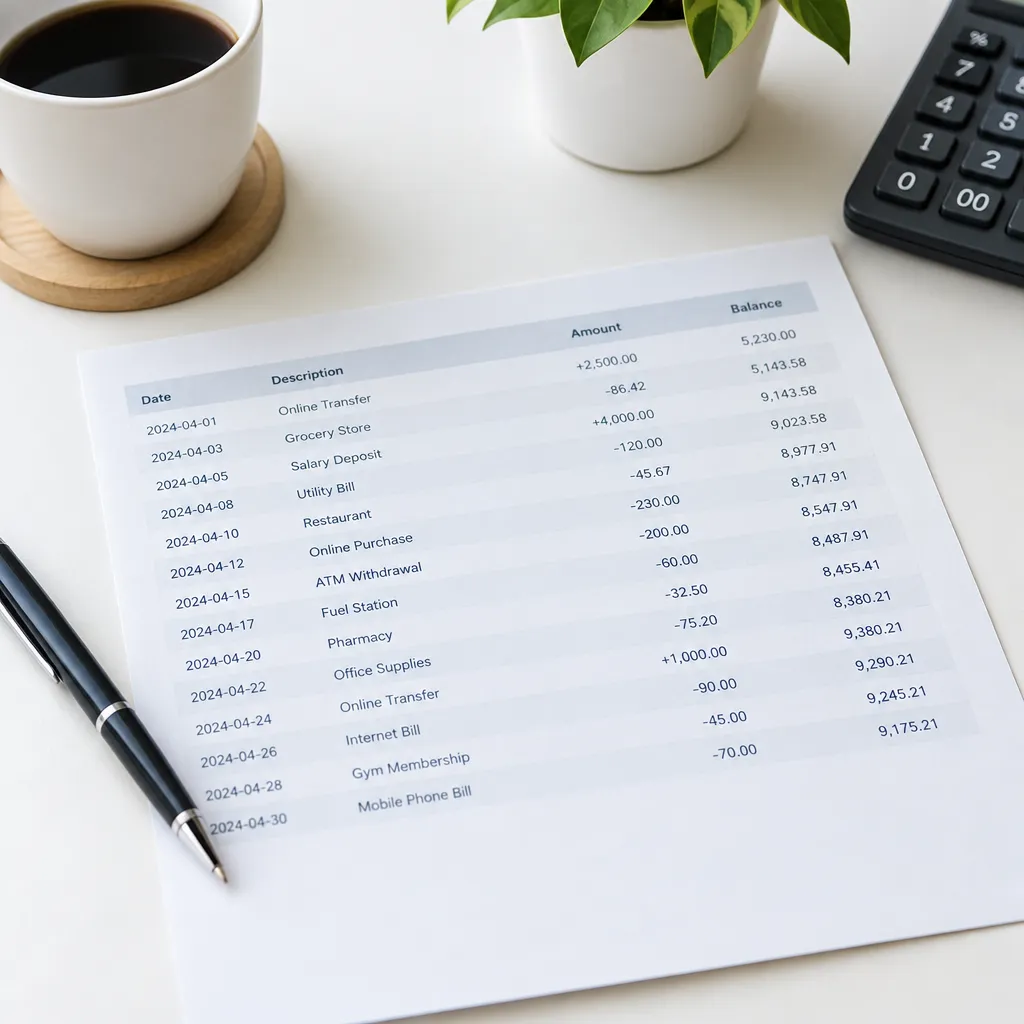
A statement may show a transaction date, a posting date, or both. The transaction date is when the payment or deposit was initiated; the posting date is when it was recorded in the account. These dates can differ, so check the bank’s labels and compare entries with receipts, payment confirmations or invoices.
For example, a customer might send payment on 2 May, while the credit appears on the statement on 3 May. When investigating a cash-flow gap or considering invoice financing UAE, compare the invoice date, expected payment date and actual bank credit date.

3. Read descriptions to identify who was paid
Descriptions provide clues about the source or destination of a transaction. A line might name a customer, supplier, card purchase, transfer or payment channel. Reference numbers can help you match an entry to an invoice or bookkeeping record, but short or abbreviated descriptions may need checking against supporting documents.
If you cannot identify a payment, note its date and amount, then look for a matching receipt, invoice or transfer confirmation before classifying it. For a wider overview of funding considerations, see how a small business can access a business loan in the UAE.
4. Identify credits and trace money coming in
Credits are amounts added to the account, such as customer receipts or incoming transfers. In the example, the AED 8,000 and AED 6,200 customer transfers increase the balance. Match each credit to the relevant customer, invoice or other source so that recorded sales and actual cash received are not confused.
A credit appearing on a statement confirms money entered the account; it does not, by itself, show which invoice it settles. If one customer pays several invoices together, use remittance details or your records to allocate the receipt accurately.
5. Identify debits and track money going out
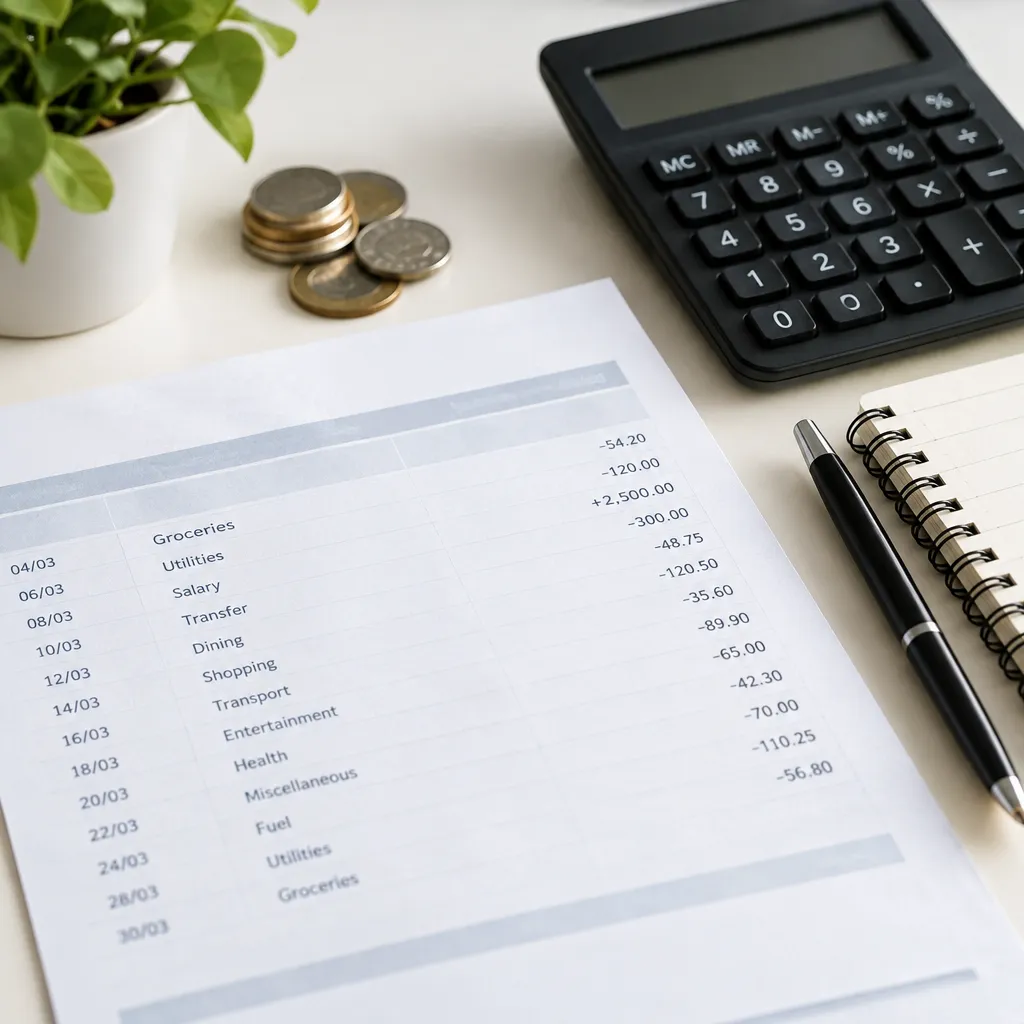
Debits are amounts taken from the account. The AED 4,500 supplier payment and AED 750 card purchase reduce the balance in the example. Check each debit against supplier invoices, card receipts, payroll records or payment approvals to confirm the amount and business purpose.
Keep business and personal transactions clearly identified in your bookkeeping. If a debit is unfamiliar, avoid assuming it is an error: first check the payment channel, reference and date, then raise a query with the bank if you still cannot identify it.
6. Follow the running balance after every entry
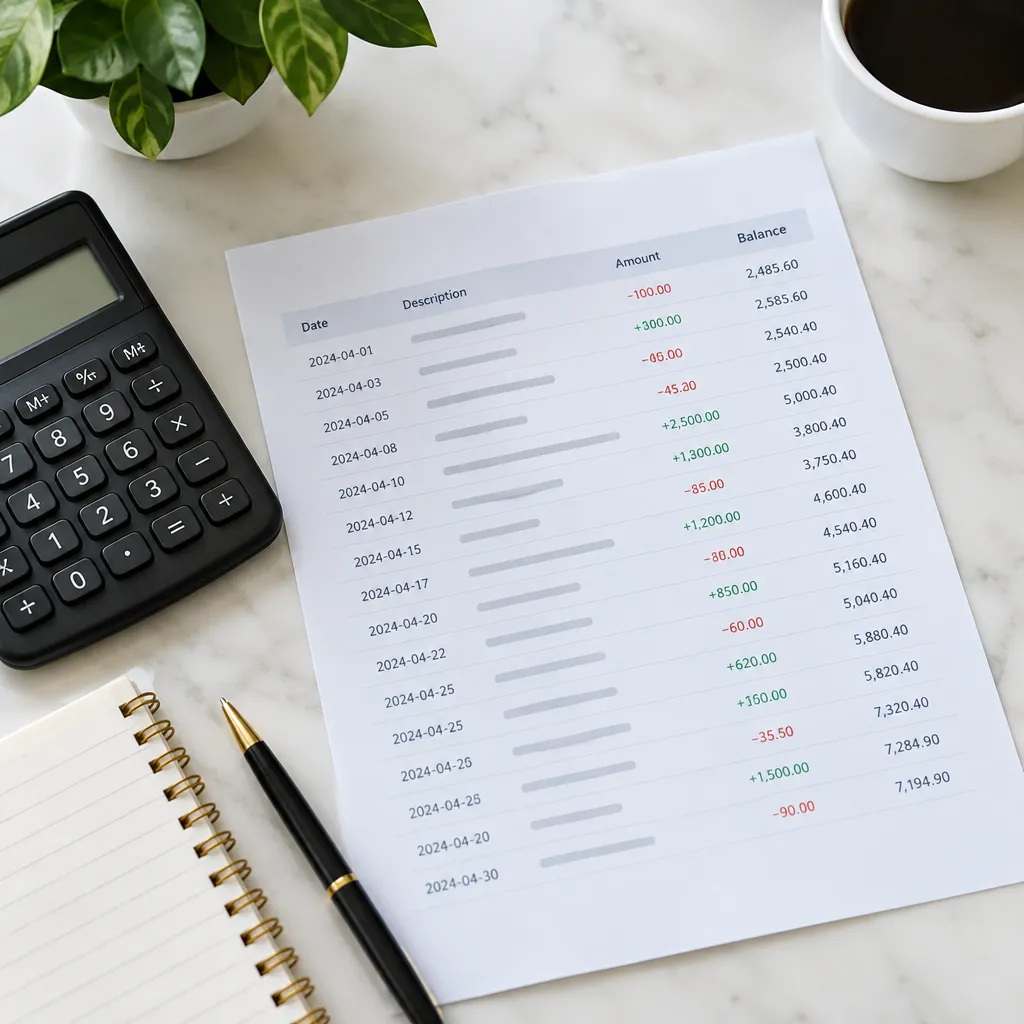
The running balance shows the account total after each posted transaction. Starting from AED 10,000, adding the AED 8,000 credit gives AED 18,000; subtracting the AED 4,500 debit leaves AED 13,500. The next AED 750 debit brings it to AED 12,750.
Continue the calculation entry by entry: add credits and subtract debits. In this example, the AED 6,200 credit brings the balance to AED 18,950, then the AED 25 fee reduces it to AED 18,925. A mismatch may indicate a missed entry or a different posting order.
7. Check fees and reconcile the statement with your records
Fees may appear as separate debits, such as the AED 25 service fee in the example. Check the fee description and compare it with the bank’s account records. Do not overlook small charges: several entries can add up, and they affect the balance available to the business.
A bank reconciliation is the process of comparing statement transactions with your accounting records and investigating differences. Check off matching entries, then review items that appear on only one side, such as a bank fee not yet recorded or a payment still awaiting posting. Consider timing differences before treating a mismatch as an error.

8. Use recent statements to prepare for SME funding
Banks and other finance providers may request recent business bank statements to understand account activity, incoming receipts, outgoing payments and cash-flow patterns. Requirements vary by provider and funding application, so check the requested date range and whether statements must be official bank-issued copies.
Before sharing them, confirm that every page is included, the account details are visible and the period is complete. A statement is one part of a funding review, not a guarantee of approval. For more on records commonly requested, see the guide to SME loan documents.
Bank Statement FAQs
What is a bank statement and example?
A bank statement is a bank-issued record of account activity over a set period. An example typically shows dates, descriptions, credits, debits, fees and a balance.
How do I get the bank statement?
Use your bank’s online banking service or app to find and download statements, or contact the bank to ask how to obtain a copy.
What is proof of bank statement?
It usually means an official statement that shows the account holder and account activity for a specified period. Check with the requesting organisation about its format and date requirements.
How can I do a bank statement?
If you mean reviewing one, check the account details and period, then match transactions to your records and verify the balances. The bank issues the statement itself.
How to create a bank statement?
A bank statement is issued by the bank, not created by the account holder. For bookkeeping, you can record transactions separately, but those records are not a substitute for an official statement.
How can I get a full bank statement?
Request or download the complete statement for the required period and check that all pages are included. If older statements are not available online, ask the bank about access.
Can a bank statement include transactions that are still pending?
A statement generally records transactions posted to the account; pending activity may appear separately in online banking. Check the bank’s labels and compare with the next statement if needed.
How long should a business keep its bank statements?
Keep statements in line with your business’s record-keeping, accounting and applicable legal requirements. Ask a qualified UAE adviser if you are unsure which retention period applies.
Recommended next steps
Use the example as a checklist: verify the statement period, identify each entry, recalculate the running balance and reconcile the result with your books. If you are preparing for a funding application, confirm the requested statement period and gather complete copies alongside the other documents required by the provider.
SYG International advises on, structures and arranges debt and equity funding for SMEs and mid-market companies across the UAE, working through banks, fintechs, private lenders and investors. SYG does not lend.
Want to know which funding option fits your business? Talk to SYG International.
Discuss your fundingSYG International advises on, structures and arranges funding. We do not lend. Final decisions, pricing and terms rest with each funding institution. This article is general information, not financial advice.